 Auscultify
The heart sounds app that trains your ear like a clinician's
Auscultation practice that actually works: daily quizzes on real heart murmurs, lung crackles and wheezes — recorded from actual patients, not synthesizers. Learn to recognize what you'll hear on rounds.
Free to download · Pro includes a 7-day free trial · Cancel anytime
Built for the way clinical skills are actually learned
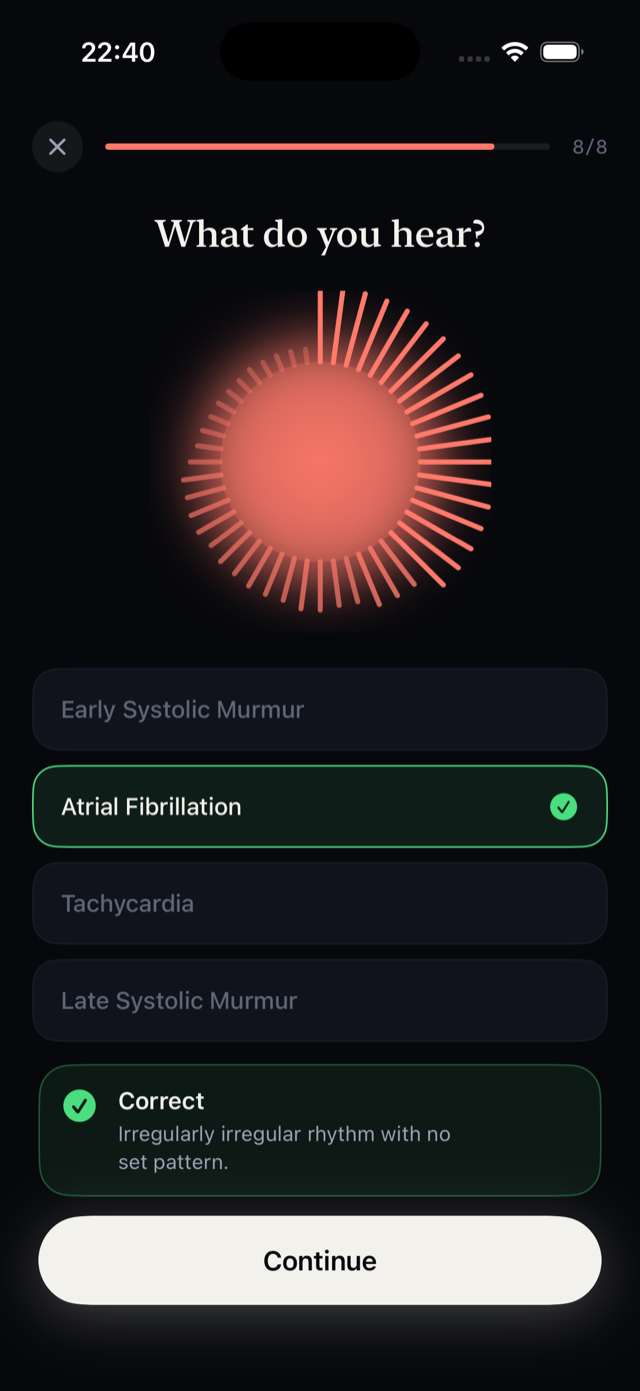
Short sessions, real audio, instant feedback — the same active-recall loop that outperforms passive reading by more than 2× after six weeks.
How Auscultify works
Ten minutes a day is enough. Here's the loop that builds a clinical ear.
Listen to a real recording
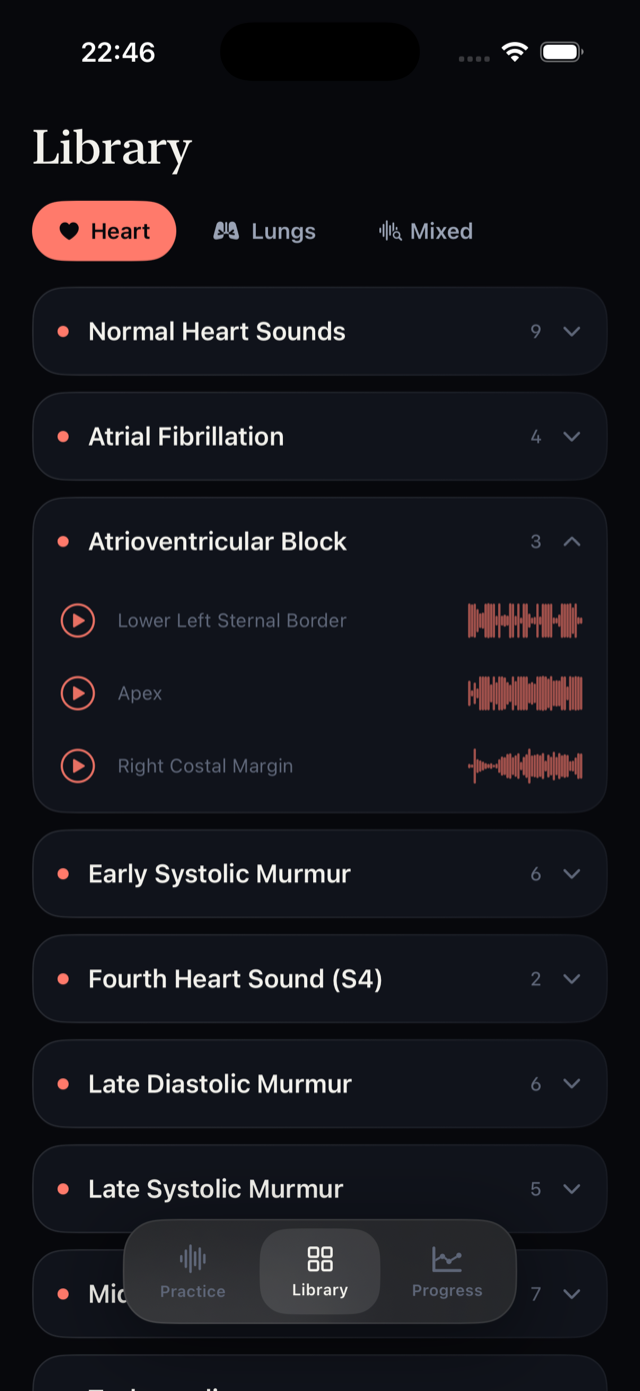
Every sound was captured from actual patients across 12 anatomical sites — aortic and pulmonic areas, lower left sternal border, apex, costal margins and six lung fields. No synthesized approximations.
Name what you hear
Is it an early systolic murmur, atrial fibrillation, fine crackles — or normal? Answer, and get instant feedback with the clinical reasoning behind every sound.
Let the app target your gaps
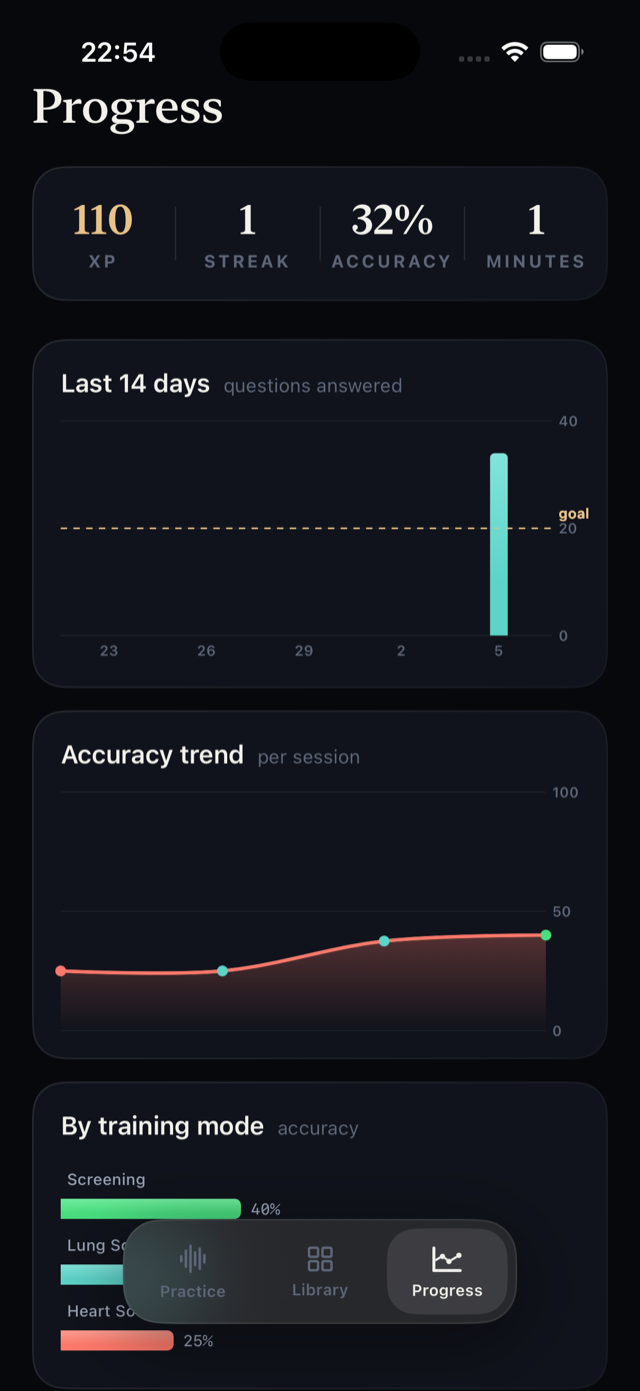
Missed sounds are weighted toward the front of your queue until you master them. A daily goal, streaks and accuracy trends keep the habit going through rotations and exam season.
Heart & lung modes
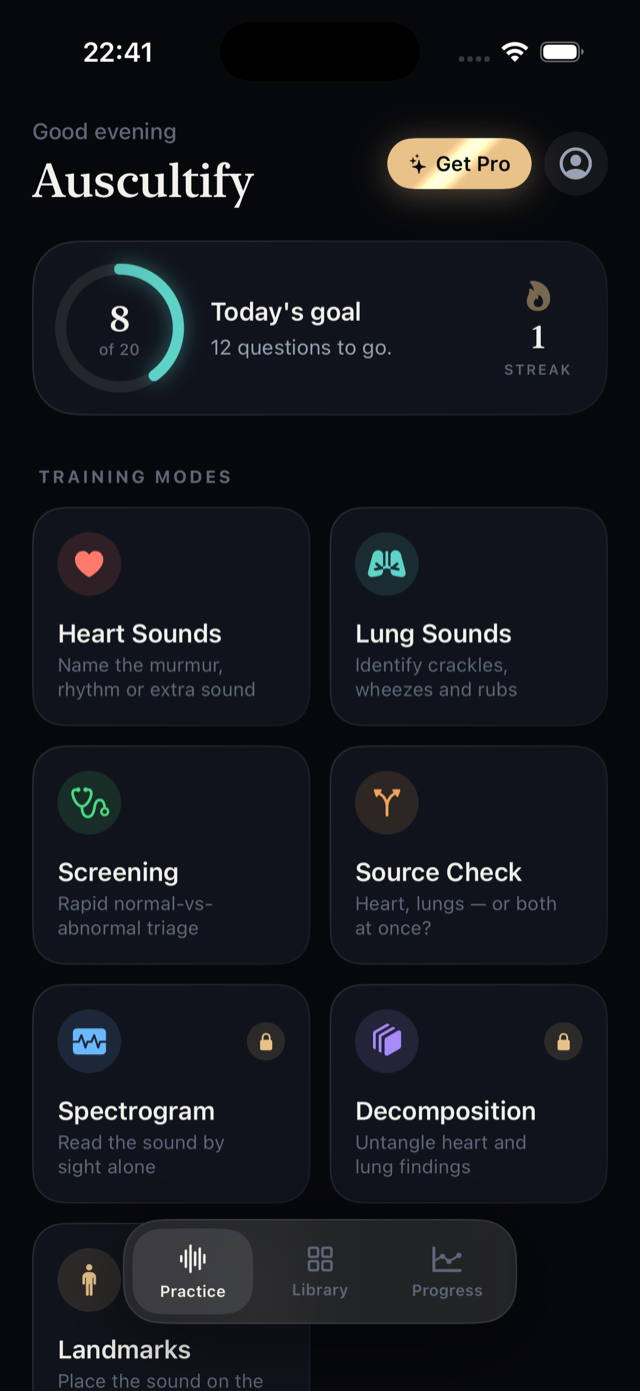
Murmurs, gallops, rhythms, crackles, wheezes and rubs — plus rapid normal-vs-abnormal screening and heart-or-lungs source checks.
Spectrogram training (Pro)
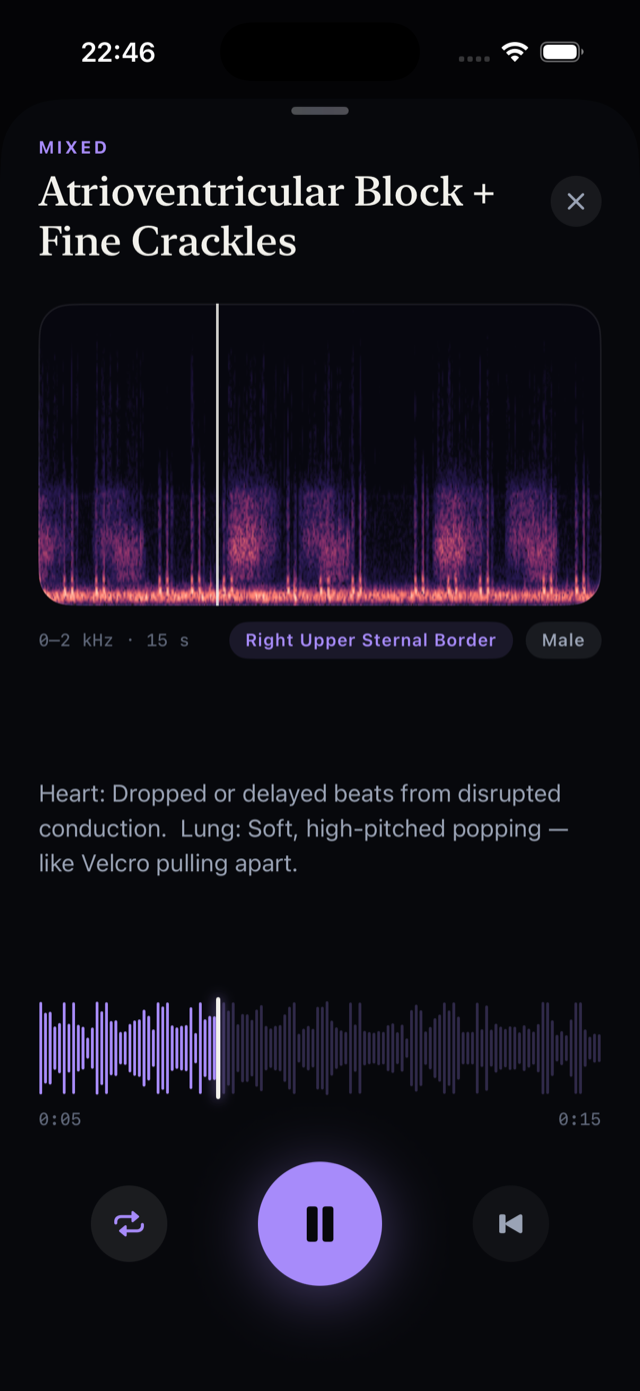
Learn to read the waveform by sight, untangle mixed heart-and-lung recordings, and drill all 12 auscultation sites on an interactive chest-wall map.
Made for exam season
Trusted by 150,000+ medical students, nursing students, residents and PAs preparing for rotations, OSCEs, USMLE and NCLEX.
Auscultation guides
Free, practical answers to the questions every student asks — and how to train each skill until it sticks.
How to Learn Heart Murmurs
A four-step method for going from "I hear... something" to naming the murmur with confidence.
Read the guide →Crackles vs Wheezes
The timing, pitch and pattern cues that separate the two most-confused lung sounds.
Read the guide →S3 vs S4 Heart Sounds
Ken-tuck-y vs Ten-nes-see: how to tell the gallops apart and what each one means.
Read the guide →Systolic vs Diastolic Murmurs
A timing-first framework for classifying any murmur you hear.
Read the guide →Heart Sounds Quiz: Test Your Ear
Why quizzing beats re-listening, and how to structure practice that transfers to the bedside.
Read the guide →Auscultation Practice That Works
A 10-minute daily routine backed by learning science.
Read the guide →Lung Sounds for Nursing Students
The six adventitious sounds to know for NCLEX and the floor.
Read the guide →Cardiac Auscultation for OSCEs
How to run the listening portion of the cardio station without freezing.
Read the guide →Heart & Lung Auscultation Sites
All 12 landmarks — where to place the stethoscope and what you should hear at each.
Read the guide →What Does AFib Sound Like?
Recognizing the irregularly irregular rhythm by ear — with real recordings.
Read the guide →Bowel Sounds Auscultation
Normal, hyperactive, hypoactive & absent — what each pattern means and where to listen.
Read the guide →Pediatric Heart & Lung Sounds
Innocent vs pathological murmurs, split S2, and the sounds unique to children.
Read the guide →Vascular Sounds & Bruits
Carotid, renal and abdominal bruits — where to listen and what they mean clinically.
Read the guide →Stethoscope Technique Guide
Diaphragm vs bell, correct pressure, patient positioning and the mistakes that cost you findings.
Read the guide →Heart Sounds & Pathophysiology
Why each murmur sounds the way it does — the hemodynamics behind every finding.
Read the guide →Reading Phonocardiograms
Interpret heart sound waveforms — diamond shapes, decrescendo slopes and spectrogram training.
Read the guide →Auscultation Cheat Sheet
Every heart murmur, gallop, click and lung sound in one quick-reference table.
Read the guide →Clinical Auscultation Cases
"Patient presents with X — what do you hear?" Case-based scenarios to test your reasoning.
Read the guide →Respiratory Auscultation for OSCEs
The chest exam station — sequence, findings and how to present like an examiner expects.
Read the guide →Normal Bowel Sounds Per Minute
The normal 5 to 30 per minute range, hyperactive and hypoactive thresholds, and how long to listen.
Read the guide →Hyperactive Bowel Sounds
Causes, rate and sound character, and when loud bowel sounds are a red flag.
Read the guide →Hypoactive & Absent Bowel Sounds
Ileus, peritonitis, opioids and late obstruction, plus how long to listen before charting absent.
Read the guide →Metallic & Tinkling Bowel Sounds
The high-pitched sounds of bowel obstruction and how they differ from ordinary hyperactivity.
Read the guide →S3 Heart Sound (Ventricular Gallop)
Causes, where to hear it, and when an S3 is normal versus a sign of heart failure.
Read the guide →S4 Heart Sound (Atrial Gallop)
Why a stiff ventricle produces an S4, what it means, and why it disappears in AFib.
Read the guide →S3 Kentucky, S4 Tennessee
The gallop mnemonic explained, the common mix-up, and how to keep them straight.
Read the guide →Can You Hear S3 in AFib?
Which extra sounds survive atrial fibrillation and why an S4 cannot.
Read the guide →S1 S2 S3 S4 Heart Sounds Explained
What causes each heart sound, where to hear it, and what loud, soft or distant sounds mean.
Read the guide →Gallop vs Murmur
How to tell a brief extra heart sound from a murmur, and the other short sounds that get confused.
Read the guide →Diastolic Murmurs
Early, mid and late diastolic murmurs, their causes, and the 1 to 4 grading scale.
Read the guide →Heart Murmur Mnemonics
MR PASS, MS ARD, RILE and the other memory hooks, with what each one actually encodes.
Read the guide →Stethoscope Bell vs Diaphragm
When to use each side for heart, lung, bowel sounds and blood pressure.
Read the guide →Cardiac Auscultation Areas (APETM)
The 5 sites of the heart, their landmarks, and what you should hear at each.
Read the guide →Lung Auscultation Sites
Anterior, posterior and lateral landmarks, the ladder pattern, and pediatric notes.
Read the guide →What Is a Bruit?
Definition, what it sounds like, bruit vs thrill, and where to listen.
Read the guide →Carotid Bruit
What it sounds like, how to auscultate, and how to separate it from transmitted aortic stenosis.
Read the guide →Renal Artery Bruit
Where to listen, what a continuous bruit means, and the link to renal artery stenosis.
Read the guide →Abdominal Aortic Bruit
Auscultating the aorta, iliac and femoral arteries, and what a bruit there suggests.
Read the guide →Frequently asked questions
What is the best app to learn heart sounds and murmurs?
The best heart sounds app is one that quizzes you on real patient recordings with instant feedback — passive listening doesn't build recognition. Auscultify does exactly that with 200+ clinical recordings across six quiz modes. Learn more →
How do I practice auscultation without patients?
Short daily quiz sessions on recorded sounds are the proven substitute: active recall with feedback outperforms passive reading by more than 2× after six weeks. Set a 10–40 question daily goal in Auscultify and let it weight your missed sounds. Learn more →
How can I tell crackles from wheezes?
Crackles are discontinuous popping sounds, usually inspiratory — think Velcro pulling apart. Wheezes are continuous high-pitched whistles, usually expiratory. Timing + continuity is the fastest discriminator. Learn more →
What's the difference between S3 and S4 heart sounds?
S3 follows S2 in early diastole (volume overload, "Ken-tuck-y"); S4 precedes S1 in late diastole (stiff ventricle, "Ten-nes-see"). Hearing them side by side is the only way the difference sticks. Learn more →
Does Auscultify help with USMLE, NCLEX and OSCE prep?
Yes — the library covers the murmurs, gallops and adventitious lung sounds those exams test, and Landmarks mode drills the stethoscope placements OSCE examiners score. Learn more →
Are the recordings real or synthesized?
Every recording was captured from actual patients across 12 anatomical sites. You train on the same mid-systolic murmurs, S3 gallops, fine crackles and expiratory wheezes you'll hear on rounds. Learn more →
What does atrial fibrillation sound like?
Irregularly irregular — no repeating pattern, varying beat intensity, no predictable gap. Auscultify has AF recordings at multiple sites so you can hear how it changes across the precordium. Learn more →
Is Auscultify free?
Yes — download free and practice every day. Pro adds spectrogram training, mixed-sound decomposition, landmark drills and unlimited sessions, with a 7-day free trial. Cancel anytime. Learn more →
Your ear is a skill.
Start training it today.
Join 150,000+ students and clinicians building auscultation skills one daily session at a time. Free to download — Pro trial included.
Download Auscultify on the App Store