 Auscultify
Heart sounds for nursing students, without the cardiology degree
You do not need to grade a murmur. You need to know normal from abnormal, recognize an S3 before the patient fills with fluid, catch an irregular rhythm, chart it correctly and know who to call. This page covers exactly that, and the app lets you practice it on real recordings.
Free to download · Pro includes a 7-day free trial · Cancel anytime
The four heart sounds every nurse must recognize
NCLEX and your clinical instructors care about recognition and response. Here is the short list, in the order they matter on the floor.
Normal S1 and S2
"Lub-dub." S1 is the mitral and tricuspid valves closing, loudest at the apex. S2 is the aortic and pulmonic valves closing, loudest at the base. Know normal cold; everything else is a deviation from it.
S3: the fluid-overload gallop
"Lub-dub-DUH," Ken-TUCK-y. Heard just after S2 at the apex with the bell. In adults it means a volume-loaded, failing ventricle. New S3 plus crackles plus weight gain is heart failure until proven otherwise. Chart it, check the lungs, call it in.
S4: the stiff-ventricle gallop
"DUH-lub-dub," TEN-nes-see. Heard just before S1, apex, bell. Points to hypertension, LVH or ischemia. Cannot occur in atrial fibrillation, which is a useful cross-check.
Murmurs
A whoosh between or after the beats. For nursing purposes: systolic (between S1 and S2) or diastolic (after S2), where it is loudest, and whether it is new. Diastolic murmurs are always abnormal.
Irregular rhythms
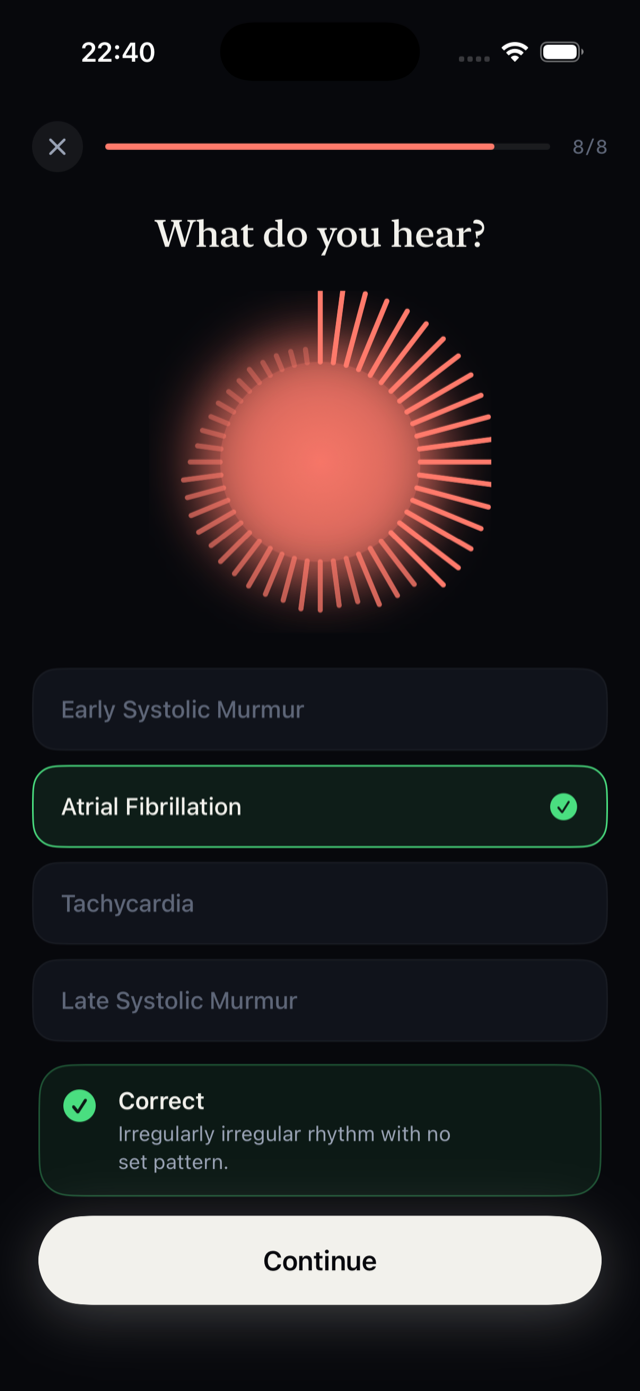
Irregularly irregular with no pattern is atrial fibrillation until an ECG says otherwise. Check the apical-radial pulse deficit, get a rhythm strip, assess perfusion.
Where to listen
Aortic (2nd right ICS), pulmonic (2nd left ICS), Erb's point (3rd left), tricuspid (lower left sternal border), mitral (apex, 5th ICS midclavicular). APE To Man.
What NCLEX actually asks about heart sounds
NCLEX-style cardiac items rarely ask you to name a valve lesion. They ask what an assessment finding means and what the nurse does next. The patterns that come up again and again:
- A new S3 in an adult → think heart failure or fluid overload. Priority: assess respiratory status, lung sounds, oxygen saturation, daily weight and intake-output; notify the provider; anticipate diuretics and fluid restriction.
- A new murmur after a myocardial infarction → possible papillary muscle rupture or septal defect. Priority: notify the provider immediately and assess for signs of cardiogenic shock.
- An irregularly irregular pulse → atrial fibrillation. Priority: apical pulse for a full minute, pulse deficit, ECG, assess for symptoms of poor perfusion and risk of stroke.
- A murmur in a child or pregnant patient → often innocent or flow-related; the nurse documents and the provider evaluates. Diastolic murmurs are never innocent.
- A pericardial friction rub after cardiac surgery or MI → pericarditis. Priority: assess for chest pain that changes with position, monitor for tamponade.
- How to listen: diaphragm for high-pitched S1, S2 and most murmurs; bell for low-pitched S3, S4 and mitral stenosis; patient leaning forward for aortic sounds, left lateral for the apex.
The guides on S3, S4, atrial fibrillation and auscultation areas go deeper on each.
The problem: you cannot learn an S3 from a sentence
Every textbook says S3 is a low-pitched sound in early diastole. That sentence has never once helped a nursing student hear one. The sound has to go into your ear, unlabeled, until you can pick it out of a real chest with breath sounds on top.
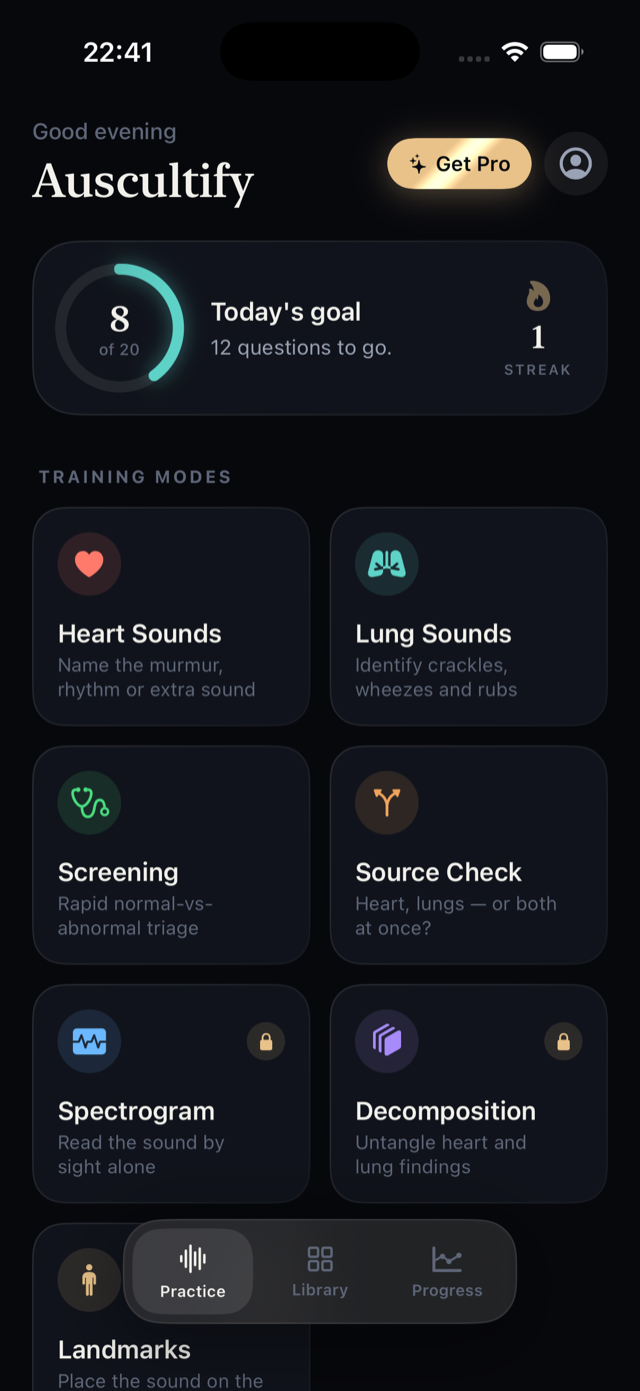
Auscultify plays real patient recordings and asks: what do you hear? You commit, you get corrected with the reasoning, and the sounds you miss come back sooner. Ten minutes a day during clinicals is enough to make S3, murmurs and AFib automatic before NCLEX.
- Real S3, S4, murmur and AFib recordings at the apex and base
- Screening mode: normal vs abnormal, fast, the way you assess on the floor
- Lung sounds mode for the crackles that go with that S3
- Progress tracking so you know you are ready
A two-week plan for nursing students
Days 1 to 4: normal and the sites
Screening mode, 20 questions a day. Learn what normal S1 S2 sounds like at each of the five sites, so the abnormal ones jump out later. Read the sites guide once.
Days 5 to 10: S3, S4, AFib, murmurs
Heart Sounds mode, 20 to 40 a day. Let the app weight your misses. Pair each sound with its nursing priority from the list above as you review feedback.
Days 11 to 14: lungs and mixed
Lung Sounds and Source Check. The S3 patient has crackles too. Finish with the clinical cases to connect sounds to scenarios.
More for nursing students
Frequently asked questions
What heart sounds do nursing students need to know?
Normal S1 and S2 at each of the five auscultation sites, the S3 gallop as a sign of fluid overload and heart failure, the S4 gallop as a sign of a stiff ventricle, systolic versus diastolic murmurs, an irregularly irregular rhythm suggesting atrial fibrillation, and a pericardial friction rub. The emphasis is on recognizing abnormal and knowing the nursing response.
Does NCLEX test heart sounds?
Yes, within physiological integrity and physical assessment. Items typically present a finding such as a new S3 or an irregular pulse and ask for the priority nursing action or the most likely interpretation, rather than asking you to name a specific valve lesion.
What does an S3 mean for a nurse?
In adults a new S3 means a volume-overloaded ventricle, most often heart failure. Assess lungs, oxygen saturation, weight and edema, notify the provider and anticipate diuretics. In children and young adults an S3 can be normal.
How do I practice heart sounds as a nursing student?
Short daily quizzes on real recordings. Auscultify's Screening mode trains normal versus abnormal, and Heart Sounds mode drills S3, S4, murmurs and AFib with instant feedback. Ten minutes a day for two weeks is enough to see your accuracy climb.
Is the app free for nursing students?
Yes. Auscultify is free to download and daily practice is free. Pro adds spectrogram training, decomposition, landmark drills and unlimited sessions, with a 7-day free trial you can cancel anytime.
Bell or diaphragm for heart sounds?
Diaphragm for S1, S2 and most murmurs, which are high-pitched. Bell, pressed lightly, for S3, S4 and the low rumble of mitral stenosis. If your stethoscope has a tunable diaphragm, light pressure acts as the bell.
Hear the S3 before
the fluid overload.
Practice on real patient recordings ten minutes a day through clinicals and NCLEX prep. Free to download, Pro trial included.
Download Auscultify on the App StoreFree to download · 7-day Pro trial · Cancel anytime