 Auscultify
Tell crackles from wheezes on the first breath
Auscultify plays real recordings of adventitious and normal breath sounds from actual patients, asks what you hear, and brings back the ones you miss. Fine crackles, coarse crackles, wheezes, rhonchi and pleural rub, across six lung fields.
Free to download · Pro includes a 7-day free trial · Cancel anytime
Every breath sound you need to recognize
Normal first, then the abnormal sounds that change management. Each one is recorded on a real patient at a real site, with the breathing pattern and background noise you will meet on the floor.
Discontinuous sounds
- Fine crackles (fibrosis, early heart failure)
- Coarse crackles (pneumonia, bronchiectasis)
- Inspiratory vs expiratory timing
- Early vs late inspiratory crackles
Continuous sounds
- Wheezes, monophonic and polyphonic
- Rhonchi that clear with cough
- Pleural friction rub
- Expiratory vs inspiratory timing
Breath sound quality
- Normal vesicular breathing at every field
- Normal vs abnormal rapid screening
- Loud, quiet and asymmetric sounds
- Heart vs lung source discrimination
Crackles vs wheezes, settled by ear not by definition
Everyone can recite that crackles are discontinuous and wheezes are continuous. The problem is a real chest where a patient is breathing fast, the heart is thumping underneath and there is a bit of both. Auscultify trains that exact moment.
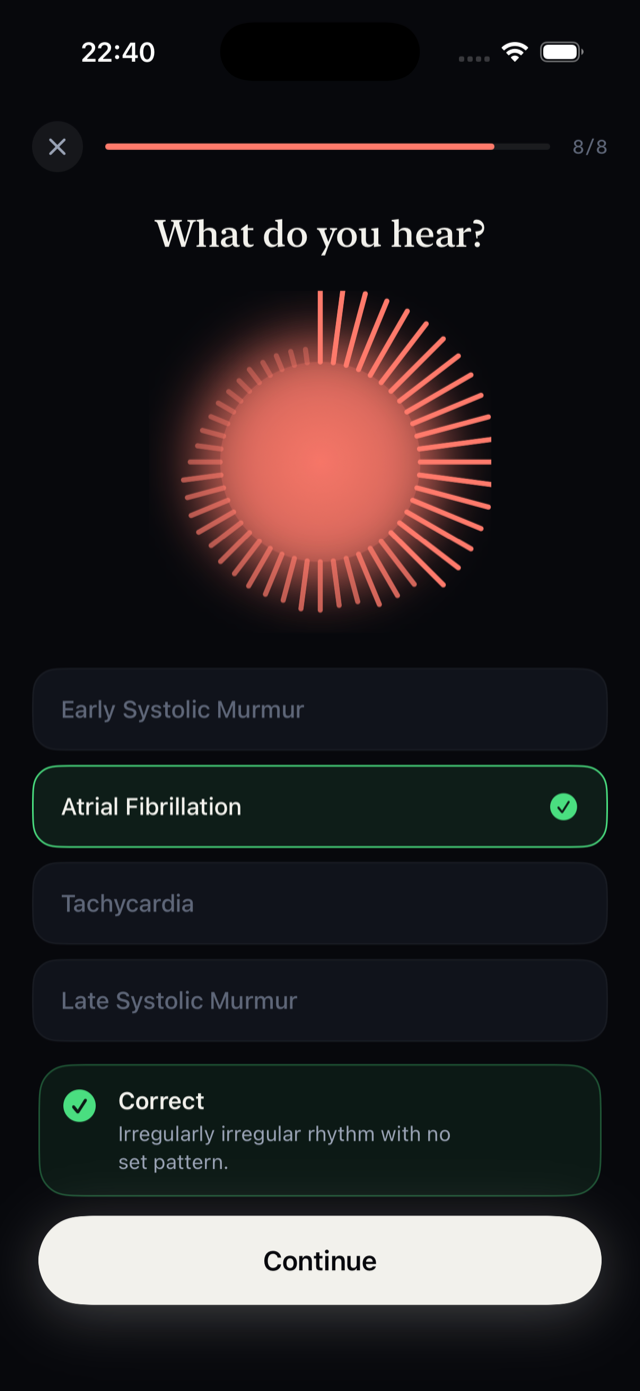
The quiz plays a recording and asks one question. You commit, you get corrected with the reasoning, and the app weights the sound to come back sooner if you missed it. In two weeks of ten-minute sessions the distinction becomes reflex.
- Instant feedback with the clinical reasoning
- Missed sounds return until you master them
- Daily goal of 10, 20 or 40 questions
- Accuracy trend for lung sounds specifically
See the crackle. Pull it apart from the heartbeat.
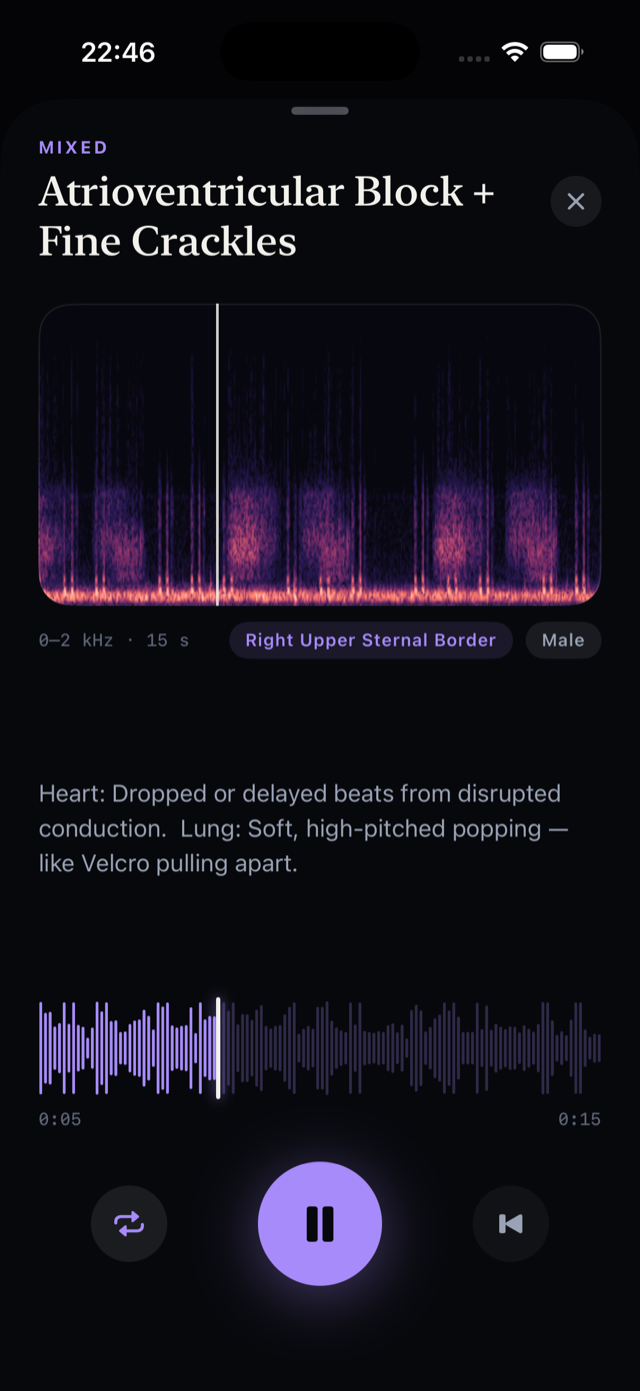
Pro adds a spectrogram synced to each recording, so you see fine crackles as short bursts late in inspiration and a wheeze as a sustained band of frequency. Decomposition mode takes a mixed heart-and-lung recording and trains you to separate the two, which is what every real chest sounds like.
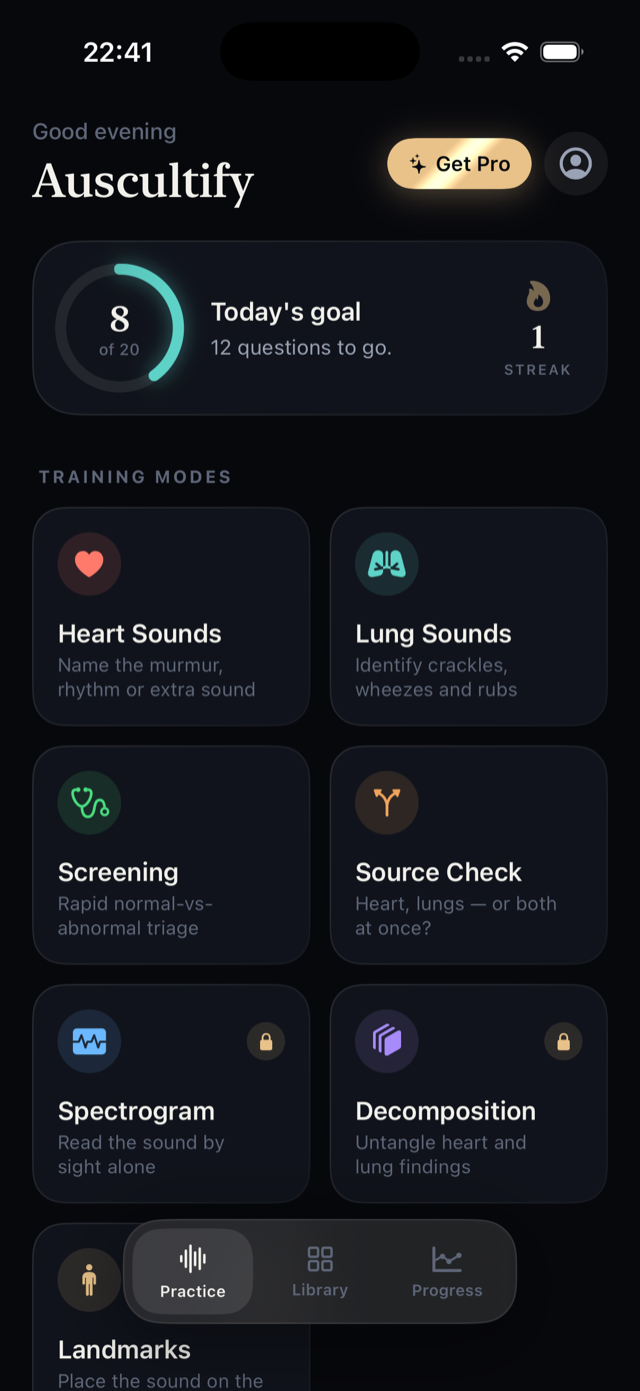
Source Check mode asks the question that catches new clinicians most: is that sound from the heart or the lungs?
- Spectrogram and waveform synced to audio
- Mixed heart-and-lung decomposition drills
- Heart-or-lungs source check mode
- Landmarks drill for all six lung fields
Who it is for
Nursing students and nurses
The six adventitious sounds NCLEX asks about and the respiratory assessment you chart every shift. Lung sounds for nursing students →
Medical and PA students
Respiratory OSCE stations, Step 1 and PANCE respiratory questions, and the first pneumonia you will hear on the wards. Respiratory OSCE →
Paramedics, RTs and EMTs
Wheeze vs crackles vs normal in the back of a truck with the engine running. The app trains your ear to pick the signal out of the noise.
Free lung sound guides to pair with the app
Frequently asked questions
Which lung sounds are included in the app?
Normal vesicular breathing, fine and coarse crackles, monophonic and polyphonic wheezes, rhonchi and pleural friction rub, recorded across six anterior lung fields, plus mixed heart-and-lung recordings.
Are the lung sounds real recordings?
Yes. Every recording was captured from an actual patient. Real crackles come with breathing noise, a heartbeat underneath and variable loudness, which is exactly what you need to train on. Synthesized sounds are too clean to transfer to the bedside.
How do I tell crackles from wheezes?
Crackles are brief, discontinuous popping sounds, usually inspiratory, like Velcro pulling apart. Wheezes are continuous, musical and usually expiratory. The fastest discriminator is continuity. The app drills the distinction with real audio until it is automatic; the free crackles vs wheezes guide covers the theory.
Does the app cover heart sounds too?
Yes. Auscultify is a full auscultation trainer with heart, lung and mixed recordings. Lung sounds is one of six modes alongside heart sounds, screening, source check, spectrogram and decomposition.
Is it free?
Free to download with daily practice at no cost. Pro unlocks spectrogram training, decomposition drills, landmark drills and unlimited sessions, with a 7-day free trial. Cancel anytime.
Is it useful for NCLEX?
Yes. NCLEX tests recognition of adventitious breath sounds and the nursing action that follows. The lung sounds mode drills the recognition, and the nursing guide covers the actions.
Do I need headphones?
Recommended. Fine crackles are high-pitched and quiet; phone speakers smear them. Any headphones work.
Crackles, wheezes, rhonchi, stridor.
Know them by ear.
Train on real patient recordings ten minutes a day. Free to download, Pro trial included, cancel anytime.
Download Auscultify on the App StoreFree to download · 7-day Pro trial · Cancel anytime